Chapter 3 · Japan
Matcha
Camellia sinensis. Shade grown tencha leaves, stone milled to powder. Sweet, grassy, umami. You drink the leaf itself.
Matcha’s paper trail begins with a monk and a boat.
Powdered tea was a Chinese invention. Under the Tang dynasty, leaves were steamed, pressed into bricks, broken off, ground and whisked with hot water and salt. Under the Song it became diancha: stone ground to fine powder, whisked in a ceramic bowl with an early bamboo whisk until it frothed, drunk by monks, scholars and the court. Then in 1191 the Zen master Eisai came back from Song China with seeds and the whisking method, planted them in Kyushu, gave some to the monk Myoe, and wrote Kissa Yojoki, drinking tea for health, the first Japanese book on tea. Monks drank it to stay awake through meditation, which remains the single most durable use case in the category.
Then China changed its mind. Under the Ming, powdered tea was abandoned in favor of steeped loose leaf, and the whisked bowl survived only in Japan. Matcha is a Chinese technology that Japan kept after its inventor discarded it.
The invention of shade, and the invention of restraint
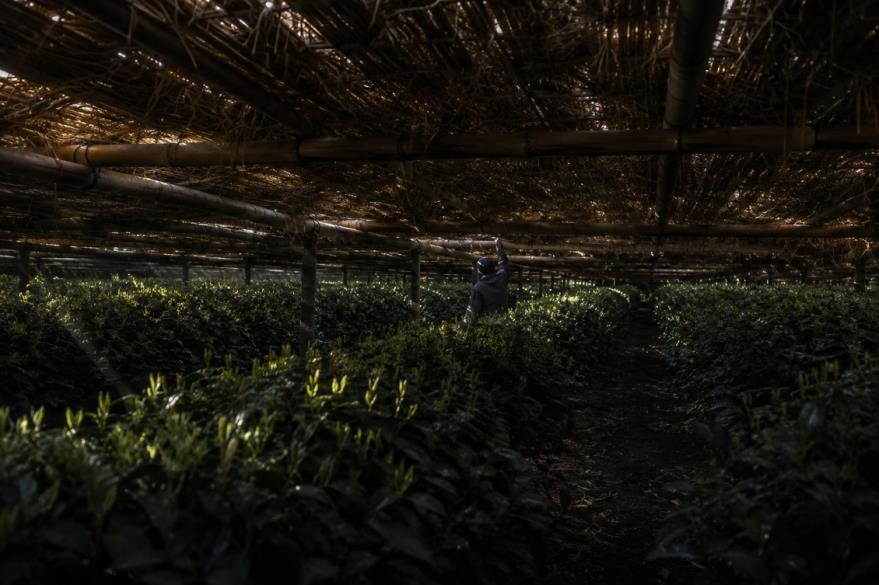
Around the fourteenth century Uji growers developed oishita saibai, shading the plants for several weeks before harvest. Deprived of full sun, the leaf concentrates chlorophyll, sweetness and L-theanine and loses astringency. The traditional method, honzu, builds a bamboo and timber shelf above the rows, lays woven reed screens across it, then spreads loose rice straw on top: ten days under reeds, ten days under straw, ending near 98 percent shade. It takes several skilled workers days to build. That single agronomic trick is what separates tencha from ordinary green tea, and it is the reason matcha cannot simply be made anywhere on demand.
What turned a stimulant into a civilizational artifact was the tea ceremony. Murata Juko brought Zen simplicity into tea gatherings in the fifteenth century. A century later Sen no Rikyu, tea master to the warlords Oda Nobunaga and Toyotomi Hideyoshi, stripped the practice to a two tatami room, rough domestic raku bowls chosen over expensive Chinese ceramics, and four principles: harmony, respect, purity, tranquility. He served the most powerful men in Japan and made plainness the ultimate luxury. His three grandsons founded schools that are still teaching today.
Every matcha latte on Bahnhofstrasse is downstream of that idea, whether or not anyone in the queue knows it.
The squeeze
Then the internet found it. Wellness culture adopted matcha as the respectable alternative to coffee, its green photographed unmistakably well, and global demand ran far past what Japan can grow. Japanese production roughly tripled between 2010 and 2023 and it was not enough.
At the Kyoto auction in May 2025 the opening tencha average reached 8,235 yen per kilogram, around 1.7 times the previous year and above the record set in 2016. That was the floor, not the ceiling. Across the season the national aggregate climbed far higher, and premium Uji lots cleared at multiples of it. Heat during the critical spring growing window cut first flush tencha production in the Uji region by roughly forty percent. Established Uji tea houses stopped taking new wholesale accounts and moved existing customers onto strict allocations. In Japan, shops began rationing to one tin per customer.
Japan’s green tea exports rose about 42 percent by volume in 2025 and roughly doubled in value. The 2026 first flush auctions confirmed that prices are stabilizing at the new elevated level rather than falling back. Japanese tencha prices, once raised, rarely come back down.
Why it cannot simply be fixed
Real matcha needs shading, careful hand work and slow stone mills, and it comes from a handful of regions. Japan lost roughly 53,000 tea farmers to retirement between 2000 and 2020 and successors are not arriving at the same rate. A newly planted field needs four to five years before first harvest, so even an aggressive planting response now does not reach shelves in volume until around 2030. The shortage is structural, not a blip.
The market is adjusting in two directions at once. Kagoshima, with flat volcanic land and mechanized shade netting, overtook Shizuoka in 2025 as Japan’s leading first flush producer after more than three decades, absorbing volume demand that Uji’s hand picked hillsides never could. At the same time Uji has repositioned upward, commanding a substantial premium as a prestige origin. One crop, two markets, moving apart.
The label nobody regulates
8,235
Opening tencha average at the Kyoto auction, May 2025, yen per kilogram
Source: Asia Pours booklet, page 17 (the squeeze figures).
-40%
Cut to first flush tencha production in the Uji region from spring heat, 2025
Source: Asia Pours booklet, page 17 (the squeeze figures).
53,000
Tea farmers lost to retirement in Japan between 2000 and 2020
Source: Asia Pours booklet, page 17 (the squeeze figures).