Chapter 1 · The Philippines
Ube
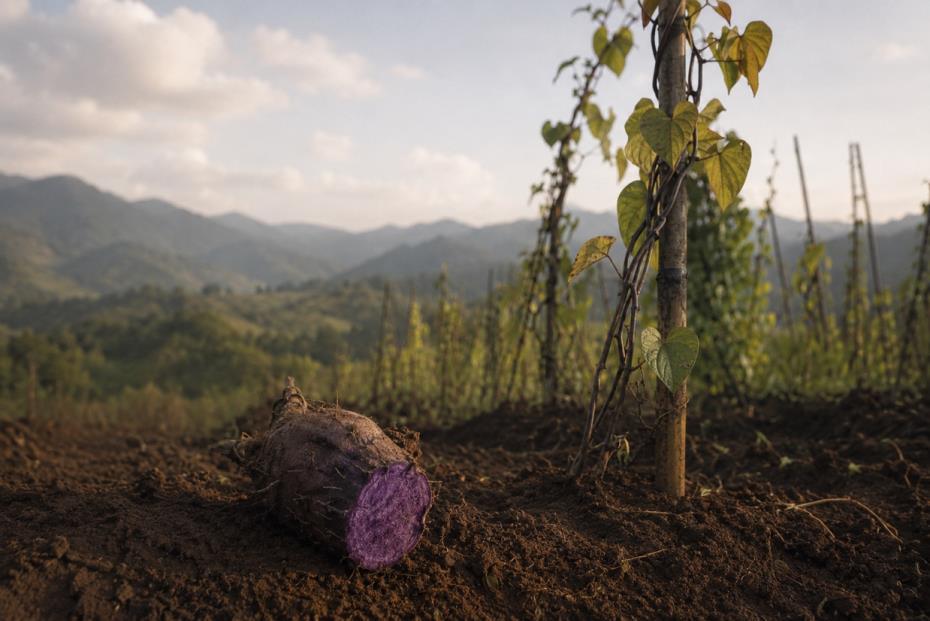
Dioscorea alata. A purple yam. Vanilla, pistachio and toasted coconut over an earthy base, with a grainy texture that survives cooking.
Start with what ube is not. It is not a purple sweet potato, not taro, and not new.
The Philippines holds the world’s highest phenotypic diversity of the species, the standard marker of a crop’s center of origin. The physical evidence sits in Ille Cave on Palawan, where archaeologists recovered charred purple yam tissue dated between roughly 8,250 and 3,050 BCE, well before the Austronesian expansion. Root crops fed these islands long before rice did. Filipinos were cooking ube before anyone in Europe had tasted a potato.
The Jesuit who counted the yams
The written trail begins in 1613, when the first Tagalog and Spanish dictionary lists it as uvi. But the best early description comes from Francisco Ignacio Alcina, a Jesuit missionary writing about the Visayas between 1667 and 1670. He found ube growing in so many kinds, colors and shapes that he gave up trying to catalog them all, and recorded tubers weighing thirteen or fourteen pounds each. The large ones, he wrote, were quinampay, the color of mulberry. They were the chief staple of Bohol.
By 1851 a Bisayan and Spanish dictionary could list more than a dozen named varieties: Baligonon, Binacsan, Binanag, Bo-ot, Lipayhan, Quinampay, Tamisan and others. This was not a crop. It was a vocabulary.
Bohol is still the emotional center of the ube story, and its largest producer at around thirty five percent of national output. Its kinampay, native to Panglao Island and Guindulman, is called the queen of Philippine yams: red purple, distinctly perfumed, unlike anything else in the genus. Ube carried Bohol through droughts, famines and war. The crop became respected enough that tradition demanded you kiss a dropped tuber in apology. Every January the island still holds an Ubi Festival for its farmers.
The boom that left the farmers behind
Around the mid 2010s ube went global. Its violet is the kind of color that survives compression on a phone screen, and Filipino American pastry chefs pushed it into the American mainstream. A purple gold rush, a violet revolution, a purple reign. Every headline agreed it was a Filipino story.
The money disagreed. Most of what is sold abroad as ube is powder, extract or flavoring rather than tubers from Filipino farms. The margin accrues to processors and brands elsewhere, and inside the country it is the middlemen who profit. Ube farmers remain among the poorest.
Why supply is falling while demand rises
Demand went up. Output halved.
The mechanics are unforgiving. Ube needs eight to eleven months in the ground, against roughly three for a potato, on small seasonal plots worked by smallholders. Then comes the trap: when prices are high, farmers sell nearly the entire harvest, leaving too few cut tubers for replanting. A good year for prices is a bad year for next year’s crop. Add drought, excessive rain and cuts to extension services, and the curve bends the wrong way. The Philippines has now begun importing raw purple yam from Vietnam to cover the gap.
There is a parallel problem of authenticity. A market in ersatz ube has grown alongside the real one, with purple sweet potato standing in for yam in boba shops and industrial bakeries. Purple has become a claim rather than a description.
The countermove worth watching
12,483
Philippine ube production in 2025, metric tons, down from roughly 30,000 in 2006
Source: Asia Pours booklet, page 7 (value chain figures).
$3.2M
Philippines' ube and ube-product exports, 2025
Source: Asia Pours booklet, page 7 (value chain figures).
$455M
Global ube market value, 2024
Source: Asia Pours booklet, page 7 (value chain figures).